Wednesday, February 23, 2011

Faint-Smiling Like A Star


This said, he rose, faint-smiling like a star
Through autumn mists, and took Peona's hand:
They stepped into the boat, and launch'd from land.
-Endymion, Book I, 1818


Today is the anniversary of the death of John Keats, who is known as one of the great poets of the Romantic period. His major works of poetry were composed between the ages of nineteen and twenty six; the age of his death. Like the other major poets of the Romantic period such as Byron or Shelley, his life was struck by complexities and tragedy. His father died due to an accident when Keats was still a child, and the rest of his immediate family, save his sister Frances, would succumb to tuberculosis . Though many people of the time would also have been struck by the effects of this horrid disease, the significance of the deaths of his family cannot be lessened. The last days of his life were wrought with pain both physical and emotional; the woman he loved was thousands of kilometers away in England, while he himself lay dying in a bed in Rome. He was unable to read the last letters Fanny Brawne wrote to him, so profound was his heartbreak.
The poems he wrote during his short and difficult life remind me that even an existence plagued by darkness and shadow can still be a source of yet unimagined beauty and light. The physical life he led was brief, though that which he produced during that life inspires us still.

For more information on Keats and the products of his life, click here.

Image 1

Tuesday, February 15, 2011

Late Night Thoughts on Books.


She is too fond of books,
and it has turned her brain.

-Louisa May Alcott


I must admit that I first encountered this sentence on a book bag I saw a lady carrying in a Winnipeg McNally Robinson. As I currently occupy my time as a history student at the graduate level, I must admit that this sentence now often comes to mind. This is especially true when I find myself poring over a book late into the night when the usual activity of the surrounding city is dulled to a sleepy state, while, at the same time, my mind and imagination race with the possibilities presented by the matter I encounter between the printed pages of text I thumb. Therefore, I consider this sentence written by Louisa May Alcott in the nineteenth century with great affection. Books have fascinated me since I can remember. Even before I could read, I remember noticing the books my parents held between their hands and considering, as they read, "What could there possibly be on those pieces of paper which demands their concentration?"


It is the potential which lies within books which has long inspired my fascination. Scholarly works provide incite into the complexities related to the authors' thoughts and processes, as well as the complexities of the subject matter. Meanwhile, works of fiction are veritable rabbit holes of possibilities. Quite selfishly, it seems that in a world where so many experiences are shared by many through television and film, books offer the possibility for individual experience. Of course many people read the same books, but the content of these books are first experienced individually. The characters and settings are subject greatly to the construction of the reader's imagination. I find that bibliophiles usually share this common understanding that books are great bastions for fantasy and thought; a sort of security blanket for the contents of one's own mind.


I find that without complexities and imagination life loses something important. What is life if one cannot dream of something greater or ponder the meaning of the surrounding world? So perhaps it is a bit odd to own eight different published version of the same book because you like the variations in their presentation. Or considering the different methodology used in that new work of social history published by the University of Toronto Press, only to realize that, yes, I am in fact grocery shopping, and, yes, I have been staring at this tomato that I hold in my hand for well over a minute. Or thinking, "What would Oscar Wilde be wearing were he alive today? Would he ride the bus?" and, "When I finally get to England I am SO going to that Charles Dickens theme park I've heard about." So, perhaps books do have the ability to "turn a brain", but books hold the potential to be a shining salve which works away life's accumulated grit.

Images 1, 2, 3, 4

Thursday, February 3, 2011

Winter Stores


Written by Charlotte Bronte,
published under the pen name Curer Bell, 1846.


We take from life one little share,
And say that this shall be
A space, redeemed from toil and care,
From tears and sadness free.

And, haply, Death unstrings his bow,
And Sorrow stands apart,
And, for a little while, we know
The sunshine of the heart.

Existence seems a summer eve,
Warm, soft, and full of peace,
Our free, unfettered feelings give
The soul its full release.

A moment, then, it takes the power
To call up thoughts that throw
Around that charmed and hallowed hour,
This life's divinest glow.

But Time, though viewlessly it flies,
And slowly, will not stay;
Alike, through clear and clouded skies,
It cleaves its silent way.

Alike the bitter cup of grief,
Alike the draught of bliss,
Its progress leaves but moment brief
For baffled lips to kiss

The sparkling draught is dried away,
The hour of rest is gone,
And urgent voices, round us, say,
"Ho, lingerer, hasten on!"

And has the soul, then, only gained,
From this brief time of ease,
A moment's rest, when overstrained,
One hurried glimpse of peace?

No; while the sun shone kindly o'er us,
And flowers bloomed round our feet,--
While many a bud of joy before us
Unclosed its petals sweet,--

An unseen work within was plying;
Like honey-seeking bee,
From flower to flower, unwearied, flying,
Laboured one faculty,--

Thoughtful for Winter's future sorrow,
Its gloom and scarcity;
Prescient to-day, of want to-morrow,
Toiled quiet Memory.

'Tis she that from each transient pleasure
Extracts a lasting good;
'Tis she that finds, in summer, treasure
To serve for winter's food.

And when Youth's summer day is vanished,
And Age brings Winter's stress,
Her stores, with hoarded sweets replenished,
Life's evening hours will bless.

Image 1

Sunday, January 9, 2011

The Circus


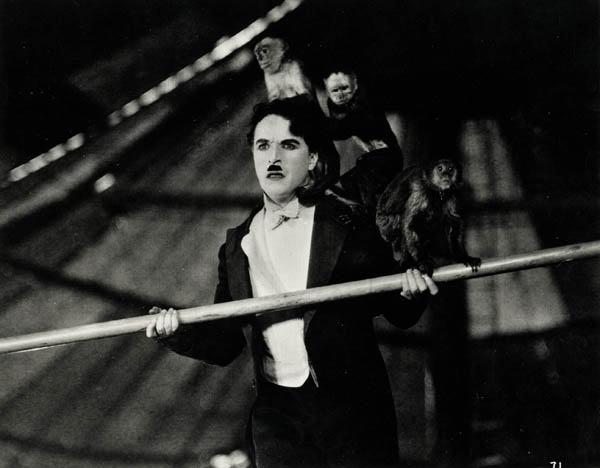
Sonya, The Girl Without Fear, sent out an invitation to go watch a Charlie Chaplin film tonight at the Cinematheque. The girl has good nerd taste; I have much to learn from her awesomeness. I had never seen an entire Chaplin film before tonight, nor had I been to the Cinematheque. This blog seems to be turning into a documentation of my encounters with (what I find to be) new and interesting aspects of arts, history and culture. I'm happy to add my experience of seeing The Circus to this blog.

Though The Circus is mainly a comedy, I also found it touching. One of the main characters, "A Circus Rider", is the stepdaughter of the Circus Proprietor who manages his show with a hard and heavy hand. The Proprietor is eager to have his audience laugh, though the same cannot be said in regards to his employees. The arrival of Chaplin's character "A Tramp" manages to cheer the beautiful yet slightly tragic figure of the Circus Rider . The interactions between the main characters in the film manage to convey more sentiments to the audience than the laughable qualities of mere slapstick.


The film begins with Chaplin singing and the film is silent, apart from an accompanying music score also composed by the legendary film star. As I sat in the flickering darkness of the theater with my popcorn, I thought of how this film couldn't possibly be fully appreciated in any other environment. I contemplated the possible number of spectators who had also applauded and laughed at the adventures of the lovable Tramp over this last century. To see a Chaplin film at the cinema, one is not only a spectator, but also manages to feel engaged in the plot alongside the film's characters. There were no 3D special effects, explosions or nudity (though you do get to see Chaplin's calves), but seeing The Circus for the first time was certainly a memorable experience. It's no wonder the films have remained popular through several generations.

Also, on April 14th, the Winnipeg Symphony Orchestra will perform the music of the film Modern Times, where Chaplin's timeless character The Tramp made his last appearance.

Images 1,2,3

Friday, December 17, 2010

Citrus Cider


I currently live in Winnipeg, Manitoba and while I do love the winters here, they are quite cold. It's always nice to have a hot drink waiting for you when you come in rosy cheeked from the cold. The following recipe is for a crockpot citrus cider which I've taken from my Better Homes & Gardens crockpot recipe book. This citrus cider is also a delicious and delightfully fragrant recipe, perfect for guests who might have to drive home after all these holiday parties going on during the season.

8 cups apple cider or apple juice
1 cup orange juice
1/2 cup lemon juice
1/4 cup honey
8 inches stick cinnamon, broken
8 whole cloves
3 slices fresh ginger

1)Combine cider, orange juice, lemon juice, and honey. Stir to dissolve honey.
2)For a spice bag, cut a 6 inch square from a double thickness of cheesecloth. Place cinnamon sticks, cloves, and ginger in the center of the cheesecloth square. Bring up corners of the cheesecloth; tie close with clean 100 percent cotton kitchen string (I just tie the corners of the cheesecloth together tightly). Add spice bag to mixture in cooker.
3)Cover and cook on low-heat setting for 5 to 6 hours or on high-heat setting for 2 1/2 to 3 hours. Remove spice bag and discard.


Grab your favourite holiday mug and enjoy some citrus cider!


Image 1

Saturday, December 4, 2010

'Oh, Whistle, and I`ll Come to You, My Lad'

I have a love for English ghost stories, particularly those stemming from the Victorian and Edwardian eras. Many of today's attempts at horror include gore and sensational storylines. I prefer the quite murmurs of fear Susan Hill inspires in readers in her book The Woman In Black. I am, as I have previously confessed, also a lover of books. When I walk into a second hand or used book store, I feel as though I am embarking on an adventure. What marvels shall I encounter? That said, I was in a used bookstore in London, Ontario a few years ago and picked up a copy of M.R. James' Collected Ghost Stories. It is a modern edition, though I love it just the same. I had never heard of this author before, but because this book had been published by the same publishers as another collection of works I enjoy, I purchased the book. The story 'Oh, Whistle, and I'll Come to You, My Lad' was the first story I read, and I made the mistake of reading the story late at night.

M.R. James (1862-1936) was a medievalist and provost of King's College Cambridge. Allegedly, he identified himself very much with the Victorian age, and did not like ways in which the 'modern' world was progressing. James never married; the academic world was his home and sanctuary. Most of his stories reflect these details about his life. His stories are cast in dusty academic settings, where the antiquarian and university professor are the heroes (or victims). The past is a mysterious entity, which, if pushed and prodded too vigorously by the curious, can retaliate and reveal its lessons with terrifying severity.

James wrote his ghost stories to entertain a select group of friends and fellow scholars at Cambridge at Christmastime. This is why I felt it appropriate to share the stories of M.R. James with you in early December, so that you may also take part in the Victorian tradition of sharing ghost stories at Christmas.

The BBC has some very good television productions of several of his stories as part of their 'Ghost Stories for Christmas' series. A View from a Hill (2005) is a good place to start, as is 'Oh, Whistle, and I'll Come to You, My Lad' (1968).

The University of Adelaide, a most useful website, has posted the collected works of M.R. James online here.

For a more complete observation of the life and works of M.R. James, as well as details of film, radio and theater productions of his stories, the site 'A Thin Ghost' is a good place to start.

Images, 1, 2, 3, 4,

Wednesday, November 3, 2010

percy bysshe shelley

though i'm not a student of english literature i sometimes fancy that i were. so many publications which have only been lately released are so attractive. while these publications are often quite tempting to read, i find myself within an episode in my life where i still wish to explore (or am simply drawn) towards authors of the past. though i am currently a slave to history and all its mystery, i find myself sneaking a copy of 'british poetry and prose' amongst my history books. i'm utterly infatuated with the romantic poets. keats, byron, shelley... their tragic and untimely ends seem only to add to the weight of their poetry.
i won't provide an overview of his life or an analysis of the following poem. i simply wish to share with fellow dreamers a poem from an old book over which i pondered late one night.


To Night

I
Swiftly walk o’er the western wave,    
Spirit of Night! Out of the misty eastern cave, 
Where, all the long and lone daylight, 
Thou wovest dreams of joy and fear, 
Which make thee terrible and dear,
  Swift be thy flight!     
II
 Wrap thy form in a mantle gray,   
Star-inwrought! 
Blind with thine hair the eyes of Day; 
Kiss her until she be wearied out, 
Then wander o’er city, and sea, and land, 
Touching all with thine opiate wand—   
Come, long-sought!     
III 
When I arose and saw the dawn,   
I sighed for thee; 
When the light rode high, and the dew was gone, 
And noon lay heavy on flower and tree, 
And the weary Day turned to his rest, 
Lingering like an unloved guest,   
I sighed for thee.      
IV 
Thy brother Death came, and cried,   
Wouldst thou me? Thy sweet child Sleep, the filmy-eyed, 
Murmured like a noontide bee, 
S
hall I nestle near thy side? 
ouldst thou me?—And I replied,   
No, not thee!     
V 
Death will come when thou art dead,   
Soon, too soon— Sleep will come when thou art fled; 
Of neither would I ask the boon I ask of thee, belovèd Night— 
Swift be thine approaching flight,   
Come soon, soon!

percy bysshe shelley would die tragically after keats but before byron under, what some say, mysterious circumstances. he died while at sea along with two others. he was one month shy of thirty.
[funeral-shelley.jpg]

The Funeral of Shelley
by Louis Edouard Fournier

images 1, 2